
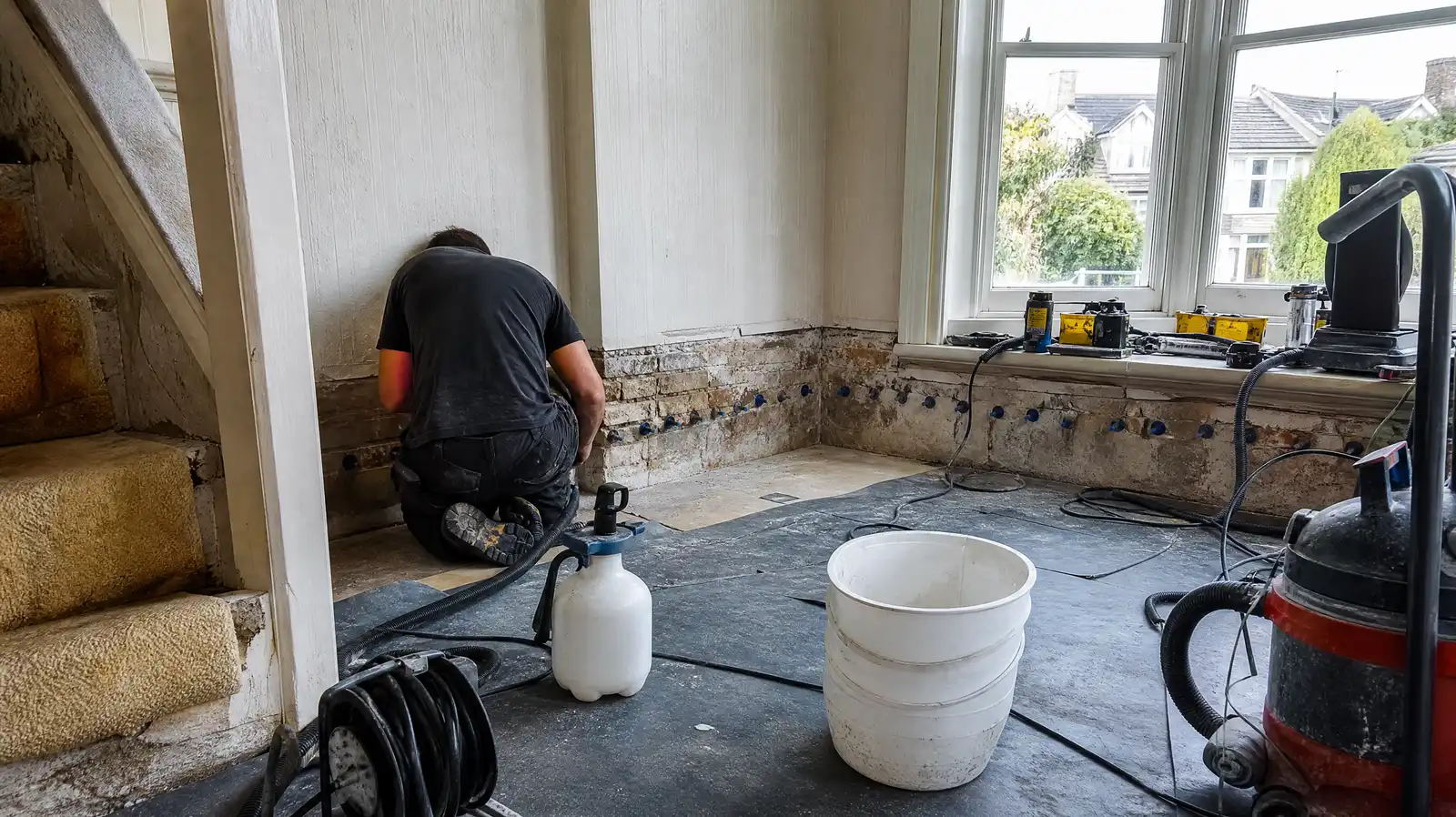
Rising Damp Treatment in Birmingham (Fixed at the Cause, Not Just the Wall)
Rising Damp Treatment in Birmingham: dry walls, a healthier home and better property value, fixed at the cause. Written quote before any work.
Call for a damp survey: 0121 330 2385 Open 7 days a week, 9am-7pm | Covering Birmingham and the West Midlands
Our promise: we find out why your wall is wet before we recommend anything, and we’ll tell you plainly if you don’t need us.
Tide marks, peeling paint and a musty smell low on the wall are worrying, but they don’t always mean what the first person through the door says they mean. At Eco Damp Proofers, we provide rising damp treatment in Birmingham, and we start by looking at gutters, pointing, ground levels and ventilation. Rising damp is real, but it is less common than its reputation. The English Housing Survey 2024 to 2025 (MHCLG) found rising damp in just 1% of English homes, while serious condensation affected 3%. Birmingham gets rain on about 133 days a year (Met Office, 1991-2020), so water has plenty of chances to find a way in. We work out which kind of damp you have and fix that.
Understanding What’s Happening in Your Wall
Rising damp is groundwater travelling up through porous brick or stone by capillary action, much like a biscuit soaking up tea. Most older Birmingham homes were built with a damp-proof course (DPC) to stop this. When that barrier fails, is bridged or was never fitted, moisture climbs and carries salts with it. Those salts leave the white, powdery deposits and the stubborn tide mark.
Rising damp rarely climbs far, so damp patches above roughly a metre usually point to something else: a leaking gutter, failed pointing, a blocked air brick or a cracked downpipe. This is why diagnosis matters more than the treatment itself.
Who Usually Needs This
- Victorian and Edwardian terraces in Erdington, Handsworth and Moseley, where original slate or bitumen DPCs have cracked or been bypassed
- Interwar semis in Sutton Coldfield and Solihull, where raised patios and flower beds often sit above the DPC
- Post-war flats and maisonettes with ground-floor walls in poor condition
- Landlords handling a damp complaint who need an accurate cause on paper
- Buyers whose survey flagged damp and who want a second, independent opinion before exchanging
How We Confirm It Really Is Rising Damp
Many homeowners have read that rising damp is over-diagnosed, and they’re right to be wary. A damp meter alone proves nothing, because it reacts to salts, foil wallpaper and condensation as readily as to groundwater. Our assessment follows the logic of BS 6576:2005, the British Standard for diagnosing rising damp and installing chemical damp-proof courses.
We look for a pattern, not a single reading:
- Height and shape. Rising damp forms a fairly even band low on the wall, usually below a metre.
- Salts. Hygroscopic salts and a tide mark point to groundwater rather than a one-off leak.
- Moisture at depth. We compare surface readings with the moisture content inside the masonry.
- The outside of the building. We check gutters, downpipes, pointing, render, drains and whether soil or paving sits above the DPC.
- Ventilation and living habits. Mould on cold walls with no tide mark often means condensation, which calls for ventilation guidance (Building Regulations Approved Document F) rather than injection.
If the cause is a gutter or a raised path, we say so. A written quote follows only when treatment is genuinely needed.
Damp-Proof Course Injection
A chemical damp-proof course is the most common fix for confirmed rising damp. It’s the treatment most people mean when they search for dpc injection.
We drill a line of small holes along the base of the wall, just above ground level, and inject a water-repellent cream or fluid. This soaks into the masonry and forms a barrier that stops moisture climbing. The work follows the approach set out in BS 6576:2005.
Who it suits: solid brick walls where the original DPC has failed, and homes where the cause has been confirmed and the external problems have been dealt with first.
What you gain: a less disruptive and usually more affordable route than a physical barrier, with no need to dig out walls or lift floors. The wall dries gradually over the following months, so the effect isn’t instant.
Injection isn’t suitable for every wall. Rubble-filled stone, very thick walls and some mixed constructions need a different approach, and we’ll explain why if yours is one of them.
Physical Damp-Proof Course Options
Where injection isn’t suitable, a physical DPC is the alternative. This means cutting a slot in the mortar course and fitting a continuous barrier, typically a membrane or slate-type layer, so water cannot pass through. It’s more involved than injection, but it creates a solid, visible barrier.
Who it’s for: properties with walls that won’t take injected fluid well, buildings where an earlier chemical treatment has failed, and cases where a surveyor or lender specifically asks for a physical barrier.
What you gain: a barrier that doesn’t rely on how the masonry absorbs fluid. The trade-off is cost and disruption, because the work takes longer and involves cutting into the wall in stages.
Other options sometimes make sense alongside or instead of a DPC. Lowering external ground levels, adding a French drain or improving subfloor ventilation can solve the problem without touching the wall’s structure. We’ll show you the cheaper option where one exists.
Replastering After Treatment
Yes, in most cases the affected plaster has to come off. Salt-contaminated plaster stays damp, flakes and pushes paint off the wall, so it needs removing, usually to about a metre above the highest damp reading.
After that we replaster with a salt-resistant, breathable system, often a sand-and-cement render coat followed by a finishing plaster. Modern gypsum plasters should not be used on the treated area because they absorb and hold moisture.
Who it’s for: anyone who has had a chemical or physical DPC installed, or whose existing plaster is stained, crumbling or visibly salted.
What you gain: a wall that looks right and stays right. Replastering is the stage that lets you redecorate, but we advise waiting until the wall has dried out, which can take time. Applying vinyl or sealed paint too soon can trap moisture, and the problem returns.
If your walls are damp-free behind the plaster, we won’t recommend replastering just for the sake of it.
From Survey to Completion
- Call us. Phone 0121 330 2385 and tell us what you’ve noticed. We’re open 7 days a week, 9am-7pm.
- Inspection. We check the damp pattern, moisture readings and the outside of the building.
- Findings explained. We tell you the cause in plain English, including if the answer is a gutter, a vent or a habit.
- Written quote. You receive it before any work starts, with cheaper options included where they exist.
- Treatment and making good. We carry out the agreed work, then replaster where needed.
What You’ll Gain
- A dry, healthier-feeling home with fewer musty smells
- Walls that can finally be redecorated and stay that way
- A documented cause and fix, which helps at sale or mortgage stage
- Less worry about repeat problems, because we deal with external causes first
- Heating that works better in a drier wall, since damp masonry is harder to warm
Landlords and Tenants: Awaab’s Law
Since 27 October 2025, Awaab’s Law requires social landlords in England to investigate significant damp and mould hazards within 10 working days, send a written summary within 3 working days of the investigation, and complete safety works within 5 working days. Emergency hazards must be dealt with within 24 hours (GOV.UK, MHCLG, 2025). The rules sit within the Hazards in Social Housing (Prescribed Requirements) (England) Regulations 2025.
Private landlords aren’t covered by those timescales, but the Housing Health and Safety Rating System (HHSRS) still treats damp and mould as a hazard they must address. The English Housing Survey 2024 to 2025 found damp in 10% of privately rented homes and 7% of social rented homes, against 4% of owner-occupied ones. Children, older people and those with existing health conditions are at greater risk (GOV.UK, MHCLG and UKHSA), which is a good reason to act promptly and keep clear records. We provide a written diagnosis you can file.
What It Costs
Prices depend on the type and severity of the damp, the treatment method, the size of the affected area, access and location (Checkatrade damp proofing cost guide, 2026). Published ranges give a useful guide:
- Chemical injection typically costs £60-£200 per metre of wall (Checkatrade, 2026).
- A chemical or injection job typically costs £1,000-£3,000 (Checkatrade, 2026).
- Retrofitting a physical damp-proof course typically costs £2,500-£7,500 (Checkatrade, 2026).
- Across the UK, damp proofing averages £1,220, with typical jobs from £772 to £1,942 (Checkatrade, 2026). In Hall Green, Birmingham, the average is £1,104 (Checkatrade, 2026).
- A damp survey on a typical property costs around £300 (Checkatrade, 2026).
These are guides, not quotes. Your price depends on what we find, and we give it to you in writing before any work begins.
Questions We Hear Most
How much does damp proofing cost in Birmingham?
In Hall Green, Birmingham, damp proofing averages £1,104 (Checkatrade, 2026). Chemical injection jobs more widely typically cost £1,000-£3,000, and a physical DPC £2,500-£7,500 (Checkatrade, 2026). Your figure depends on wall length, severity, access and whether replastering is needed. We provide a written quote before any work starts.
Is rising damp a myth?
No, but it is over-diagnosed. The English Housing Survey 2024 to 2025 found rising damp in 1% of English homes, against 3% for serious condensation and 2% for penetrating damp. Many “rising damp” quotes turn out to be gutters, pointing or condensation. That’s why we rule those out first, then confirm the pattern.
Is a free damp survey worth it?
Yes, if it finds the real cause. Ours is free and there’s no obligation. We can usually visit within 3 working days, check outside as well as in, and explain the cause in plain English. If the fix is a gutter or better ventilation, we say so before quoting for anything bigger.
Who is responsible for damp in a rented home?
Usually the landlord, where the cause is structural, such as a failed DPC, leaking gutter or defective pointing. Social landlords in England must meet Awaab’s Law timescales for significant hazards (GOV.UK, 2025). Private landlords must still address damp hazards under the HHSRS. Tenants can help by reporting early and keeping rooms ventilated and heated.
Will damp stop me selling or getting a mortgage?
Not necessarily. Buyers and lenders mainly want to know the cause has been identified and fixed. A written diagnosis, a dated treatment record and evidence that external causes were dealt with all help. Untreated, unexplained damp is what tends to cause problems, so a clear paper trail is worth having whichever way a survey went.
Talk to a Local Team
If you’re seeing tide marks, flaking plaster or a musty smell, ring us before you book anyone else. We’ll explain what’s likely going on and what to do next, even if the answer is a new downpipe. Call for a damp survey: 0121 330 2385. We’re open 7 days a week, 9am-7pm, covering Sutton Coldfield, Moseley, Handsworth, Solihull, Walsall and the rest of Birmingham. If you’d rather write, use the enquiry form and we’ll call you back.


How It Works
From initial survey to completion — here’s what to expect when you work with us.
-
Call or send a message
Tell us what you can see. We ask a few questions and book a visit at a time that suits you, any day 9am–7pm.
-
We find the cause
We check inside and out: readings across the walls, gutters, pointing, ground levels, ventilation and timbers.
-
Written quote
You get the cause, the fix and the price in writing, including any cheaper options, before any work starts.
-
We do the work
Our own team carries out the treatment, leaves the house tidy and explains how long the walls need to dry.
Related Guides
Helpful articles to learn more about this service.
Rising Damp or Condensation? How to Tell the Difference
Rising damp or condensation? Learn the tell-tale signs, a simple home check and what to rule out first, plus when Rising Damp Treatment is really needed.
Read guide →Rising Damp Treatment Cost in Birmingham (2026)
Rising damp treatment cost in Birmingham explained: sourced 2026 price ranges, what changes the price and how to spot over-diagnosis before you pay for treatment.
Read guide →Damp, mould or a musty smell? Let's find the cause.
Call us 7 days a week, 9am–7pm. We can usually do a free survey within 3 working days, find what's really causing it, and give you a written quote before any work starts.