
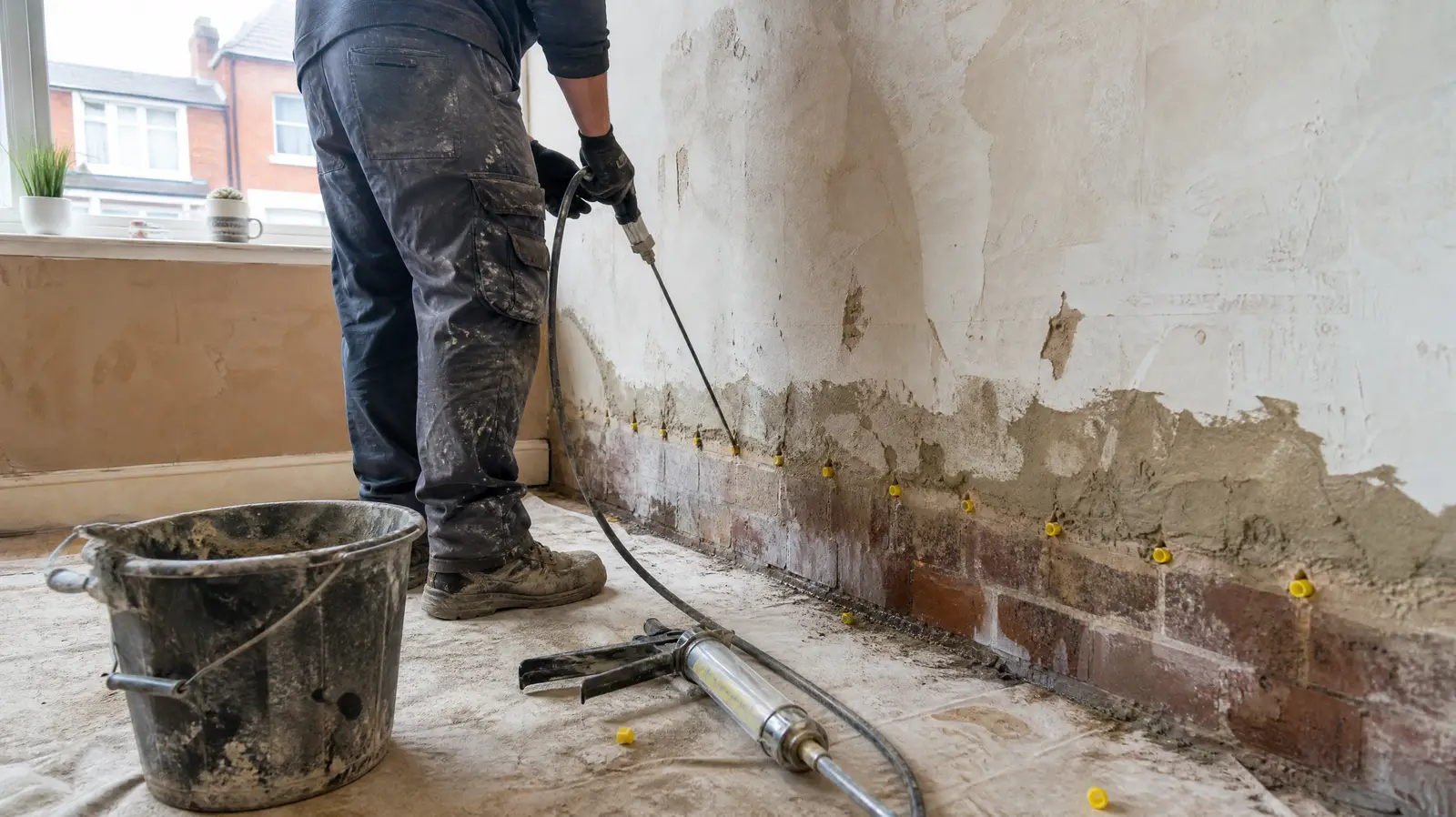
Rising Damp Treatment Cost in Birmingham (2026): What You Should Actually Pay
Rising damp treatment cost in Birmingham explained: sourced 2026 price ranges, what changes the price and how to spot over-diagnosis before you pay for treatment.
If you’ve been quoted a four-figure sum for damp, it’s worth knowing what’s normal before you agree to anything. At Eco Damp Proofers, we’re a local team covering Birmingham and the West Midlands, and we’d rather tell you plainly what a job should cost than sell you something you don’t need. This guide sets out typical rising damp treatment cost figures, what pushes a price up or down, and how to check you’re paying for the right fix. To talk it through, call 0121 330 2385, open 7 days, 9am to 7pm.
What does rising damp treatment cost?
Chemical injection typically costs £60 to £200 per metre of wall (Checkatrade damp proofing cost guide, 2026). A chemical or injection job as a whole typically costs £1,000 to £3,000 (Checkatrade, 2026), while retrofitting a physical damp-proof course typically costs £2,500 to £7,500 (Checkatrade, 2026).
For a wider picture, Checkatrade’s UK listings put the average damp proofing job at £1,220, with typical jobs from £772 to £1,942 (Checkatrade damp proofers in the United Kingdom, 2026). Closer to home, the average in Hall Green, Birmingham is £1,104 (Checkatrade damp proofers in Hall Green, 2026). A typical whole-property job comes to around £5,000, plus around £300 for a damp survey (Checkatrade, 2026).
Those are published ranges, not our quote. Every property is different, which is why we put a written quote in your hands before any work starts, including cheaper options where they exist.
Why prices vary so much
The same guide says the price depends on the type and severity of the damp, the treatment method, the size of the affected area, access, and the property’s location (Checkatrade, 2026). In Birmingham, that plays out in a few familiar ways:
- Wall length and thickness. A solid-brick Victorian or Edwardian terrace in Handsworth or Moseley has thick walls and more metres to treat than a small interwar semi.
- Access. Fitted kitchens, built-in wardrobes and tight party walls all add labour.
- Replastering. Injection only stops moisture rising. Salt-contaminated plaster usually needs to come off and be redone, which is a separate line on the quote.
- Whether it’s rising damp at all. This one matters most, and it’s the next section.
Is it really rising damp?
Many Birmingham homeowners have read that rising damp is over-diagnosed, and they’re right to be cautious. The English Housing Survey 2024 to 2025 (MHCLG) found serious condensation was the most common form of damp in English homes at 3%, ahead of penetrating damp at 2% and rising damp at 1%.
So before we recommend any treatment, we check the likelier culprits first:
- Gutters and downpipes. Birmingham averages about 809 mm of rain a year, with rain on about 133 days (Met Office, Winterbourne, 1991-2020). A leaking joint soaks a wall for months.
- Pointing and brickwork. Failed mortar lets rain straight in.
- Ground levels. Paths, patios or soil built up above the original damp-proof course bridge it.
- Ventilation and condensation. Mould on cold external walls, worse in winter, often points here.
True rising damp tends to show as a tide-line of staining low on the wall, often with crumbling plaster and salts. If we find that, we’ll say so, and the work is carried out with BS 6576, the British Standard for diagnosing rising damp and installing chemical damp-proof courses, in mind. If it’s a gutter, we’ll tell you, and the fix can cost a fraction of an injection job.
How to compare quotes sensibly
A fair quote should name the cause it has found, not just the treatment. Check that it:
- Explains why the damp is rising damp rather than condensation or a leak.
- Lists wall lengths, plaster removal and replastering as separate items.
- Says what happens if the cause turns out to be something simpler.
- Is in writing before work begins.
If a surveyor skips the diagnosis and goes straight to a price, ask why. Our full approach is on our rising damp treatment page.
Key takeaways
- Injection typically costs £60 to £200 per metre of wall (Checkatrade, 2026), and a typical job £1,000 to £3,000 (Checkatrade, 2026).
- Price depends on severity, method, area, access and location.
- Rising damp is the least common form of damp in English homes at 1% (English Housing Survey 2024 to 2025).
- Rule out gutters, pointing, ground levels and condensation before paying for injection.
- Get the quote in writing, with replastering itemised.
Get a straight answer on your walls
Not sure what you’re dealing with? Call 0121 330 2385 for a damp survey. We cover Erdington, Sutton Coldfield, Moseley, Handsworth, Solihull and Walsall, and we’ll tell you plainly if you don’t need us.
Frequently Asked Questions
The average in Hall Green, Birmingham is £1,104 (Checkatrade, 2026), while a typical injection job runs £1,000 to £3,000 (Checkatrade, 2026). Your figure depends on wall length, severity, access and replastering, so a written quote after a proper inspection is the only reliable number.
Often, yes. Plaster that has absorbed ground salts stays damp and can't hold paint well, so affected areas are usually stripped and replastered. It isn't always needed, and a good quote lists it separately so you can see exactly what you're paying for.
No, but it is over-diagnosed. The English Housing Survey 2024 to 2025 found rising damp in 1% of English homes, behind condensation at 3% and penetrating damp at 2%. It does happen, particularly where a damp-proof course has failed, so diagnosis should come before treatment.
Damp, mould or a musty smell? Let's find the cause.
Call us 7 days a week, 9am–7pm. We can usually do a free survey within 3 working days, find what's really causing it, and give you a written quote before any work starts.