
Dry Rot or Wet Rot? How to Tell, and What It Costs (Birmingham Guide)
Dry rot or wet rot? Learn the signs, how they differ and what repairs cost in Birmingham, plus when Dry Rot and Wet Rot Treatment is really needed.
Soft, crumbling or sour-smelling timber is worrying, but the first job is working out whether you have dry rot or wet rot, because the repair, and the bill, can be very different. At Eco Damp Proofers we start with the cause of the moisture, not the label. This guide explains how the two differ, what to look for in a Birmingham home, and what repairs typically cost. If you would rather talk it through, call 0121 330 2385. We are open 7 days, 9am–7pm.
What is the difference between dry rot and wet rot?
Dry rot (Serpula lacrymans) can spread through masonry and across timber that is not itself wet, while wet rot stays where the timber is damp. Both are fungal decay fed by moisture. Wet rot is usually the more localised and easier problem. Dry rot is more serious because it can travel.
Despite the name, dry rot still needs a moisture source to start. It simply spreads further from that source once established. Wet rot needs continued dampness, so it rarely strays beyond the wet area, and fixing the leak or damp source usually stops it.
Birmingham’s climate gives both a helping hand. The Met Office records about 809 mm of rain a year at Winterbourne, with 1 mm or more falling on about 133 days a year (1991–2020 averages). Victorian and Edwardian terraces in Erdington, Handsworth and Moseley, with old gutters and tired pointing, are well used to that.
How can you spot the signs of dry rot?
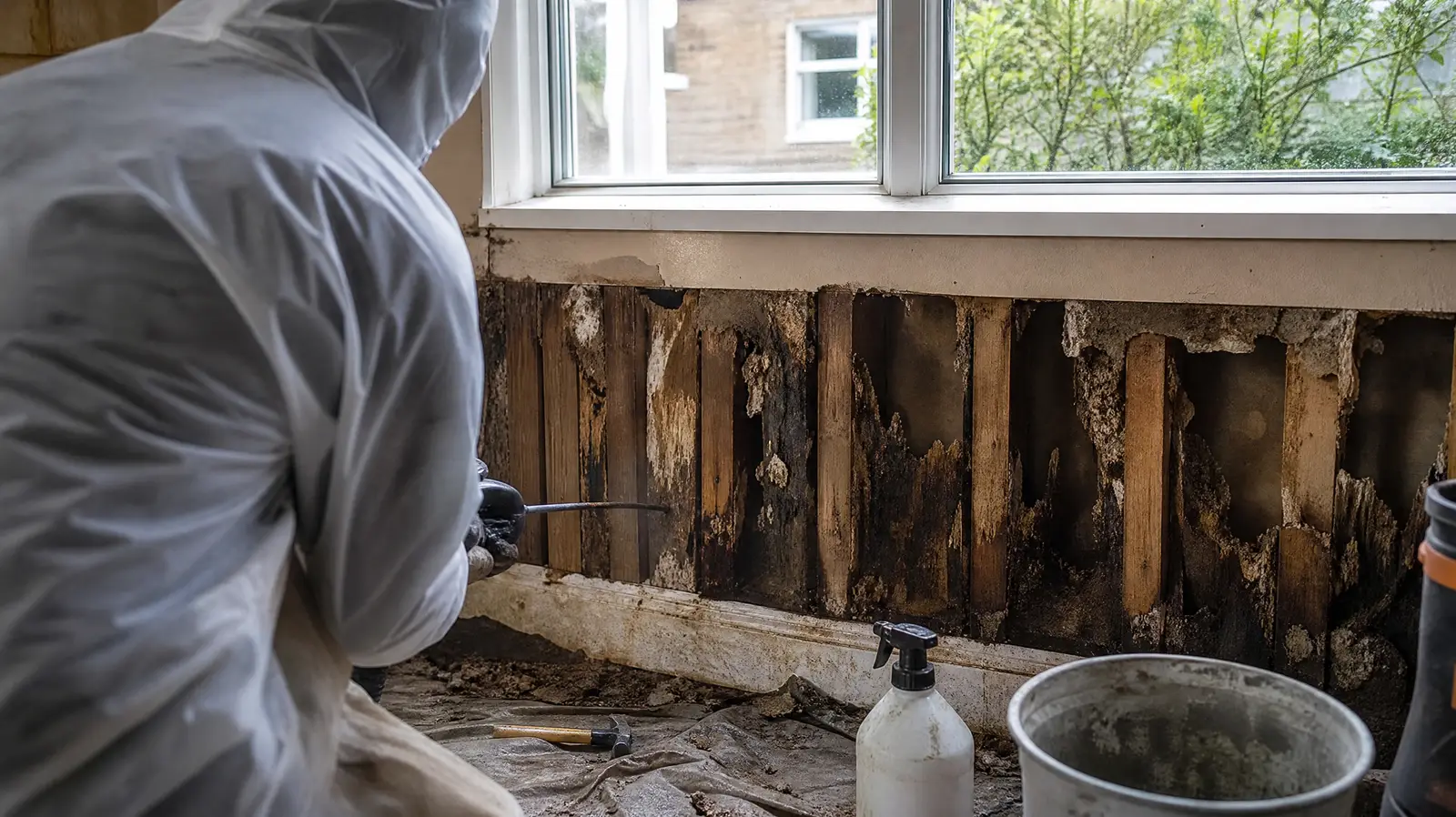
Dry rot typically leaves timber dark, shrunken and cracked into cube-shaped blocks, often with a musty, mushroomy smell. You may also see grey-white strands, a flat fluffy growth, or rust-coloured spore dust. Wet rot tends to leave timber soft, spongy and darker, with decay confined to the damp patch.
A few practical checks:
- Probe the timber. Gently push a screwdriver into a skirting board or joist. Wet rot feels soft and stringy. Dry rot often breaks into dry, brittle cubes.
- Look at the spread. Decay that stops neatly at the edge of a damp patch points to wet rot. Strands reaching across brickwork or into neighbouring timbers suggest dry rot.
- Check the smell and location. Dry rot favours unventilated spaces such as under floors, behind panelling and in cupboards under stairs.
Do not rip out timber to investigate, as that can spread spores. A proper inspection identifies the fungus and the moisture source. Fungi can also look similar, so it is worth having it identified before you spend money.
Why do floorboards rot, and is it always serious?
Wet rot in floorboards usually comes from a leaking pipe, a blocked air brick or damp from the ground below. Boards near bathrooms, kitchens and external walls are most at risk. Many cases are modest: replacing a few boards and fixing the leak or ventilation is often all that is needed, with no chemical treatment.
In older Birmingham houses, suspended timber floors rely on air bricks to keep the void below dry. When ground levels creep up, or someone has patio-ed over a vent, that airflow stops. Fixing ventilation, gutters, pointing and ground levels comes first, as it is the cheapest way to stop decay returning.
Our dry rot and wet rot treatment service follows this order. We find the water first, then repair or replace only the timber that has failed.
What does dry rot treatment cost?
Checkatrade’s dry rot repair cost guide (2026) puts the average cost to fix dry rot at £4,603, with structural wood rot repair typically costing £4,000–£12,000. Wet rot caught early usually sits well below that, because the work is more localised.
Price depends on how far the decay has spread, how much timber must be replaced, how easy the area is to reach, and whether masonry needs treating. Checkatrade’s damp proofing cost guide (2026) lists similar drivers: severity, treatment method, area size and access.
We give you a written quote before any work starts, including cheaper options where they exist. If the answer is a gutter repair and a new air brick, we will tell you plainly.
Key takeaways
- Dry rot can spread through masonry; wet rot stays in damp timber.
- Cube cracking, grey strands and rust-coloured dust point towards dry rot.
- Fixing the moisture source comes before any timber treatment.
- Checkatrade (2026) averages £4,603 for dry rot repairs, and £4,000–£12,000 for structural rot repair.
- Get the fungus identified before agreeing costly work.
Get a clear answer on your timber
If you have soft floorboards, cracked skirting or a musty smell, call 0121 330 2385 for a damp survey. Our team covers Sutton Coldfield, Solihull, Walsall and beyond. Call for a damp survey and we will find the cause first.
Frequently Asked Questions
Checkatrade's 2026 guide gives an average of £4,603 to fix dry rot, and £4,000–£12,000 for structural wood rot repair. Your price depends on spread, access and timber replaced. We provide a written quote before work starts, with cheaper options where they exist.
No. They are different fungi, so one does not become the other. However, the same damp conditions can allow either to develop. Treating the moisture source early helps prevent both, and a proper inspection confirms which one you actually have.
Not always. Wet rot often needs only the decayed sections cut out and replaced, once the timber is dry. Dry rot usually calls for more thorough removal. The extent depends on how far the decay has travelled, which an inspection will establish.
Damp, mould or a musty smell? Let's find the cause.
Call us 7 days a week, 9am–7pm. We can usually do a free survey within 3 working days, find what's really causing it, and give you a written quote before any work starts.